前文已经分析了 HashMap ,根据其实现,了解到其元素无序特性。今天来分析下两个能保证元素顺序的 Map —— 保证插入顺序的 LinkedHashMap 和可自定义排序规则的 TreeMap ,来看看到底是怎么实现有序的。
注:本文基于jdk_1.8.0_162
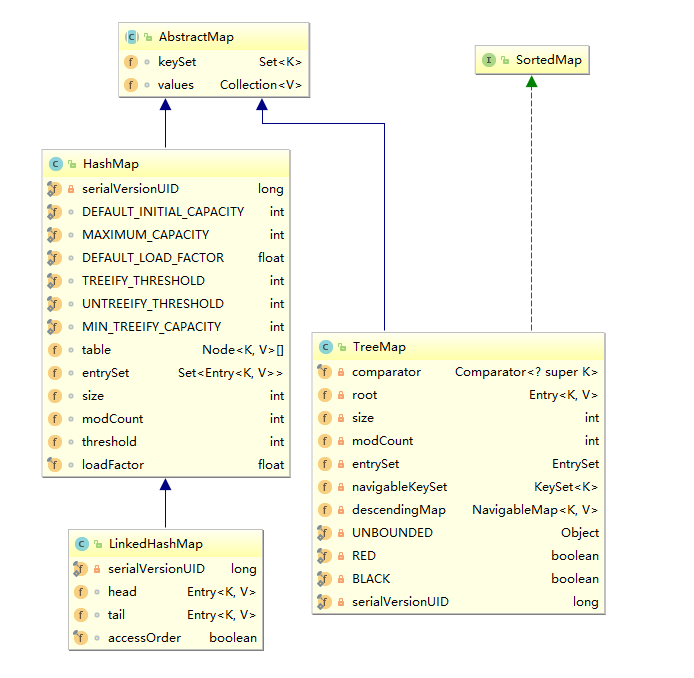
LinkedHashMap
内部结构
总览
LinkedHashMap 是继承自 HashMap 的,或重写或实现了父类中的部分方法,在一定程度上体现了多态。LinkedHashMap 通过多维护了一个插入顺序的链表,保证了元素的访问顺序。同时,属性 accessOrder 可以设置调节元素顺序,便于实现 LRU 算法。
LinkedList = HashMap + LinkedList
主要成员
主要成员如下:
1
2
3
4
5
6
7
8
| public class LinkedHashMap<K,V> extends HashMap<K,V> implements Map<K,V> {
transient LinkedHashMap.Entry<K,V> head;
transient LinkedHashMap.Entry<K,V> tail;
final boolean accessOrder;
}
|
其中,Entry 的结构如下,继承自 HashMap.Node ,并维护了元素的前后节点信息:
1
2
3
4
5
6
| static class Entry<K,V> extends HashMap.Node<K,V> {
Entry<K,V> before, after;
Entry(int hash, K key, V value, Node<K,V> next) {
super(hash, key, value, next);
}
}
|
父类埋点之重点方法
LinkedHashMap 继承自 HashMap ,基本实现上复用父类,具体可参考:Java集合分析之Map-从HashMap说起 。LinkedHashMap 主要实现了 HashMap 中定义了,但是未实现的三个方法:
void afterNodeAccess(Node<K,V> p) { }
void afterNodeInsertion(boolean evict) { }
void afterNodeRemoval(Node<K,V> p) { }
afterNodeAccess 方法
1
2
3
4
5
6
7
8
9
10
11
12
13
14
15
16
17
18
19
20
21
22
23
24
25
26
27
28
29
30
| void afterNodeAccess(Node<K,V> e) {
LinkedHashMap.Entry<K,V> last;
if (accessOrder && (last = tail) != e) {
LinkedHashMap.Entry<K,V> p =
(LinkedHashMap.Entry<K,V>)e, b = p.before, a = p.after;
p.after = null;
if (b == null)
head = a;
else
b.after = a;
if (a != null)
a.before = b;
else
last = b;
if (last == null)
head = p;
else {
p.before = last;
last.after = p;
}
tail = p;
++modCount;
}
}
|
此方法在 put 和 get 操作时会调用。如果 accessOrder == true ,在 put 之后就算是对元素进行了访问,这时就会更新链表,把该元素放至链表最后。
afterNodeInsertion 方法
1
2
3
4
5
6
7
8
9
10
11
| void afterNodeInsertion(boolean evict) {
LinkedHashMap.Entry<K,V> first;
if (evict && (first = head) != null && removeEldestEntry(first)) {
K key = first.key;
removeNode(hash(key), key, null, false, true);
}
}
protected boolean removeEldestEntry(Map.Entry<K,V> eldest) {
return false;
}
|
这个就是实现 LRU 算法的关键地方了,要实现移除规则,需将 accessOrder 设置为 true 。
afterNodeRemoval 方法
1
2
3
4
5
6
7
8
9
10
11
12
13
| void afterNodeRemoval(Node<K,V> e) {
LinkedHashMap.Entry<K,V> p =
(LinkedHashMap.Entry<K,V>)e, b = p.before, a = p.after;
p.before = p.after = null;
if (b == null)
head = a;
else
b.after = a;
if (a == null)
tail = b;
else
a.before = b;
}
|
此方法会在移除元素时调用。由于 LinkedHashMap 同时维护了一个双向链表来记录元素顺序,所以,在移除元素的时候,会调整此链表。
这三个方法,就是比 HashMap 多出来的用于维护访问顺序的方法,保证了链表元素从前到后依次是从旧到新。
元素存取方法
put 方法
put 方法并没重写,只是在实现了 afterNodeInsertion 后,记录了元素的插入顺序。有兴趣的可以回看之前的 HashMap 分析文章。
get 方法
1
2
3
4
5
6
7
8
9
| public V get(Object key) {
Node<K,V> e;
if ((e = getNode(hash(key), key)) == null)
return null;
if (accessOrder)
afterNodeAccess(e);
return e.value;
}
|
get 操作就没什么特别的了,和 HashMap 一样的方式取到元素节点。如果设置了 accessOrder ,则维护链表的顺序。
LRU算法
通过上文的分析,我们可以利用 LinkedHashMap 很轻松的实现 LRU 算法。
1
2
3
4
5
6
7
8
9
10
11
12
13
14
15
16
17
18
19
20
21
22
23
24
25
26
27
28
29
30
31
32
33
34
35
| public class LRUCache<K, V> extends LinkedHashMap<K, V> {
private Integer maxSize;
public LRUCache(Integer maxSize, int initCapacity, float loadFactor) {
super(initCapacity, loadFactor, true);
this.maxSize = maxSize;
}
public LRUCache(int maxSize) {
this(maxSize, 16, 0.75f);
}
public LRUCache() {
this(Integer.MAX_VALUE);
}
@Override
protected boolean removeEldestEntry(Map.Entry<K,V> eldest) {
return size() > maxSize;
}
public static void main(String[] args) {
Map<String, Integer> cache = new LRUCache<>(3);
cache.put("aaa", 1);
cache.put("bbb", 1);
System.out.println(cache);
cache.put("ccc", 1);
cache.get("aaa");
System.out.println(cache);
cache.put("ddd", 1);
System.out.println(cache);
}
}
|
运行结果如下,可以看出,元素顺序会在访问时调整,同时也会淘汰最不常用数据。
{aaa=1, bbb=1}
{bbb=1, ccc=1, aaa=1}
{ccc=1, aaa=1, ddd=1}
TreeMap
内部构造
总览
TreeMap 继承自 AbstractMap ,实现了 NavigableMap ,根据用户自定义的比较器或者 Key.compareTo 作为排序依据,并使用红黑树来进行实现。
主要成员
1
2
3
4
5
6
7
8
9
10
| public class TreeMap<K,V>
extends AbstractMap<K,V>
implements NavigableMap<K,V>, Cloneable, java.io.Serializable {
private final Comparator<? super K> comparator;
private transient Entry<K,V> root;
private transient int size = 0;
private transient int modCount = 0;
}
|
TreeMap 排序首先看比较器,如果无比较器才会再使用 Key 的比较规则来排序,下文会讲。 Entry 存放的是红黑树的节点数据,数据结构如下:
1
2
3
4
5
6
7
8
| static final class Entry<K,V> implements Map.Entry<K,V> {
K key;
V value;
Entry<K,V> left;
Entry<K,V> right;
Entry<K,V> parent;
boolean color = BLACK;
}
|
节点包含了键值对、父节点、左子节点、右子节点,以及红黑树相关信息。本文只研究 TreeMap 的实现,不具体研究红黑树相关知识。
构造器
1
2
3
4
5
6
7
8
9
10
11
12
13
14
15
16
17
18
19
20
21
22
23
24
25
26
|
public TreeMap() {
comparator = null;
}
public TreeMap(Comparator<? super K> comparator) {
this.comparator = comparator;
}
public TreeMap(Map<? extends K, ? extends V> m) {
comparator = null;
putAll(m);
}
public TreeMap(SortedMap<K, ? extends V> m) {
comparator = m.comparator();
try {
buildFromSorted(m.size(), m.entrySet().iterator(), null, null);
} catch (java.io.IOException cannotHappen) {
} catch (ClassNotFoundException cannotHappen) {
}
}
|
元素存取方法
put 方法
1
2
3
4
5
6
7
8
9
10
11
12
13
14
15
16
17
18
19
20
21
22
23
24
25
26
27
28
29
30
31
32
33
34
35
36
37
38
39
40
41
42
43
44
45
46
47
48
49
50
51
52
53
54
55
56
57
58
59
60
61
62
63
64
65
66
67
68
69
70
| public V put(K key, V value) {
Entry<K,V> t = root;
if (t == null) {
compare(key, key);
root = new Entry<>(key, value, null);
size = 1;
modCount++;
return null;
}
int cmp;
Entry<K,V> parent;
Comparator<? super K> cpr = comparator;
if (cpr != null) {
do {
parent = t;
cmp = cpr.compare(key, t.key);
if (cmp < 0)
t = t.left;
else if (cmp > 0)
t = t.right;
else
return t.setValue(value);
} while (t != null);
}
else {
if (key == null)
throw new NullPointerException();
@SuppressWarnings("unchecked")
Comparable<? super K> k = (Comparable<? super K>) key;
do {
parent = t;
cmp = k.compareTo(t.key);
if (cmp < 0)
t = t.left;
else if (cmp > 0)
t = t.right;
else
return t.setValue(value);
} while (t != null);
}
Entry<K,V> e = new Entry<>(key, value, parent);
if (cmp < 0)
parent.left = e;
else
parent.right = e;
fixAfterInsertion(e);
size++;
modCount++;
return null;
}
final int compare(Object k1, Object k2) {
return comparator==null ? ((Comparable<? super K>)k1).compareTo((K)k2)
: comparator.compare((K)k1, (K)k2);
}
|
从 put 方法可以看出,对于 TreeMap 而言,在使用的时候,要么 Key 实现了 Comparable ,要么传入了 Comparator ,这点很重要。同时,其它的一系列操作,基本都会分这两种情况做处理。同时,Comparator 的优先级是高于 Comparable 的。
get 方法
1
2
3
4
5
6
7
8
9
10
11
12
13
14
15
16
17
18
19
20
21
22
23
24
25
26
27
28
29
30
31
32
33
34
35
36
37
38
39
40
41
42
43
44
45
46
47
48
| public V get(Object key) {
Entry<K,V> p = getEntry(key);
return (p==null ? null : p.value);
}
final Entry<K,V> getEntry(Object key) {
if (comparator != null)
return getEntryUsingComparator(key);
if (key == null)
throw new NullPointerException();
@SuppressWarnings("unchecked")
Comparable<? super K> k = (Comparable<? super K>) key;
Entry<K,V> p = root;
while (p != null) {
int cmp = k.compareTo(p.key);
if (cmp < 0)
p = p.left;
else if (cmp > 0)
p = p.right;
else
return p;
}
return null;
}
final Entry<K,V> getEntryUsingComparator(Object key) {
@SuppressWarnings("unchecked")
K k = (K) key;
Comparator<? super K> cpr = comparator;
if (cpr != null) {
Entry<K,V> p = root;
while (p != null) {
int cmp = cpr.compare(k, p.key);
if (cmp < 0)
p = p.left;
else if (cmp > 0)
p = p.right;
else
return p;
}
}
return null;
}
|
get 方法再次印证了,Comparator 的优先级是高于 Comparable 的。
remove 方法
1
2
3
4
5
6
7
8
9
10
11
12
| public V remove(Object key) {
Entry<K,V> p = getEntry(key);
if (p == null)
return null;
V oldValue = p.value;
deleteEntry(p);
return oldValue;
}
|
总结
LinkedHashMap 实际是 HashMap + LinkedListLinkedHashMap 可用来实现 LRU 算法TreeMap 根据使用者定义的排序规则来进行排序,并使用 红黑树 来进行实现TreeMap 的 Key 不可为空,因为需要调用比较器或者 Key 的 compareTo 方法TreeMap 判断是否同一个元素是根据 Comparator 或 Comparable ,而不是 hashcode 和 equalsTreeMap 如果定义了比较器,Key 可以不实现 Comparable 接口TreeMap 比较器规则优先于 Key 的比较规则